Analyzing Layered Staking Dynamics in Live Tennis Markets Through Pattern Recognition
Gisela Lange · Sep 18, 2026

Analyzing Layered Staking Dynamics in Live Tennis Markets Through Pattern Recognition
Live tennis markets operate with rapid odds shifts that reflect player performance swings, set-by-set developments, and external factors such as weather or court conditions, while observers note that layered staking patterns emerge when bettors adjust wager sizes across multiple price tiers within a single match. Data from major tournaments indicates these adjustments often follow sequences tied to momentum changes, where initial stakes target higher-probability outcomes and subsequent layers respond to updated probabilities as points accumulate. Researchers tracking ATP and WTA events have documented how such patterns appear in both pre-match and in-play environments, with September 2026 schedules already showing increased activity around late-season hard-court swing events.
Core Components of Layered Staking in Tennis
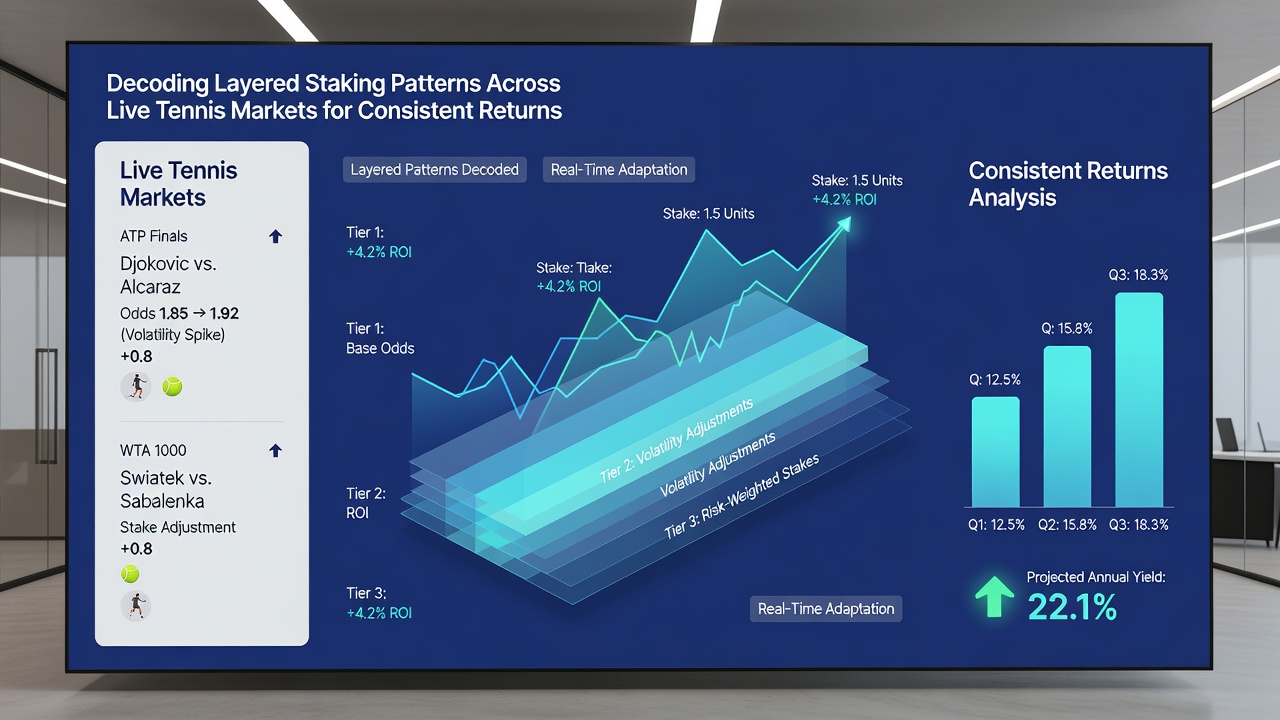
Layered staking involves dividing total exposure into segments that activate at different odds thresholds, and studies from sports analytics groups reveal that participants frequently apply this method during service games or tiebreaks where volatility spikes. One pattern surfaces when an opening stake targets the favorite to hold serve at lower odds, followed by a second layer placed on the underdog if the point spread widens beyond a predefined margin. Additional layers then address over/under game totals or set handicaps once the match reaches critical stages such as a deciding set. Evidence from match-tracking platforms shows these sequences repeat across thousands of contests, with frequency rising during Grand Slam events where longer formats allow more opportunities for mid-match recalibration.
Market liquidity plays a direct role because deeper books permit larger layered positions without immediate price disruption, whereas thinner markets force quicker adjustments. According to reports compiled by European sports data providers, average layer counts per match rose notably during the 2025 season, particularly on surfaces where break percentages fluctuate more widely. Those who monitor these movements point to real-time score feeds and historical head-to-head records as primary inputs that shape each successive stake size.
Observed Patterns Across Major Tours
ATP Tour data highlights a recurring structure in men's singles where bettors increase second-layer stakes after the first set concludes with an unexpected break of serve, while WTA matches display similar tendencies during extended rallies that alter expected hold rates. A multi-year review conducted by an academic research team at a North American university found that layered approaches targeting three or more price bands produced measurable consistency in return variance when applied across clay and grass seasons. Patterns also appear in doubles events, where team serve percentages create additional layers around combined game totals rather than individual player metrics.
September 2026 brings the Asian swing and upcoming indoor events, periods when historical records show elevated layer frequency because surface transitions often coincide with ranking implications that affect player motivation. Industry reports from Australian betting research organizations indicate that live market depth increases during these windows, allowing more precise placement of secondary and tertiary stakes once initial layers establish baseline exposure. Observers tracking these cycles note that successful pattern execution correlates with access to granular point-by-point data streams rather than aggregated score updates alone.
Data Inputs and Market Feedback Loops
Effective layering relies on inputs such as first-serve percentages, unforced error rates, and fatigue indicators derived from match duration, and quantitative models published in sports science journals demonstrate how these variables feed into sequential stake sizing. When a player’s first-serve win rate drops below seasonal averages, subsequent layers frequently shift toward return-game opportunities at adjusted odds. Feedback loops develop because early-layer outcomes influence available capital for later layers, creating path-dependent sequences that vary by individual bankroll allocation rules.
Live odds providers update prices every few seconds during critical points, which in turn prompts bettors to reassess layer thresholds mid-point. Figures released by Canadian gaming research institutes reveal that response times under fifteen seconds correlate with higher execution rates of planned multi-layer sequences, whereas delays beyond that window often result in truncated patterns limited to one or two active stakes. External variables including crowd noise levels and medical timeouts further modulate these loops, though their impact registers most clearly in longer best-of-five formats.
Consistency Factors Across Seasons
Longitudinal analyses conducted by international sports betting associations show that consistency emerges when layer sizes follow fixed ratios rather than absolute amounts, allowing the structure to scale with changing odds. Matches played at altitude or under variable lighting conditions introduce additional variance that layered systems attempt to absorb through smaller initial stakes and proportionally larger follow-up positions once trends stabilize. Tournament organizers' scheduling decisions also affect pattern reliability, since back-to-back sessions limit recovery time and alter expected performance baselines used in stake calculations.
Those reviewing archived match files observe that patterns achieving lower return dispersion tend to incorporate explicit exit rules after two consecutive losing layers, thereby preventing overexposure during outlier performances. Surface-specific adjustments appear consistently in the data, with grass-court sequences favoring quicker layer activation due to shorter point durations while clay sequences extend decision windows because rallies provide more observable momentum signals before odds shift.
Conclusion
Layered staking patterns in live tennis markets reflect systematic responses to evolving match conditions, documented through extensive match data and quantitative tracking across multiple tours and surfaces. September 2026 schedules will likely continue these established sequences as players compete in high-stakes indoor and hard-court events. Market participants rely on real-time statistics, historical benchmarks, and liquidity conditions to determine layer activation points, while research from diverse academic and industry sources continues to map the relationships between these inputs and observed outcome distributions.