Bankroll Foundations: Crafting a Resilient Fund Structure for New Sports Bettors
Morgan Keller · Mar 31, 2026

Bankroll Foundations: Crafting a Resilient Fund Structure for New Sports Bettors
Understanding Bankroll Management in Sports Betting
Experts define bankroll management as the disciplined allocation and oversight of betting funds, a practice that separates casual wagers from structured approaches aimed at longevity; researchers at the UNLV International Gaming Institute emphasize how this method underpins sustainable participation, particularly for beginners navigating volatile sports outcomes. Data from industry trackers reveals that bettors employing strict bankroll rules experience 25-30% fewer drawdowns compared to those betting intuitively, while studies indicate consistent unit sizing correlates with prolonged activity spans exceeding six months. What's interesting is how simple divisions—like treating the total fund as a series of fixed units—transform erratic staking into a repeatable system, one that withstands losing streaks without derailing overall progress.
And yet, newcomers often overlook this foundation; observers note that without a blueprint, funds evaporate quickly amid the excitement of major events, such as the upcoming March 2026 NCAA March Madness tournament where betting volumes spike dramatically. Turns out, structuring funds isn't about restrictive limits but about creating buffers that allow calculated risks to compound over time.
Establishing Your Starting Bankroll
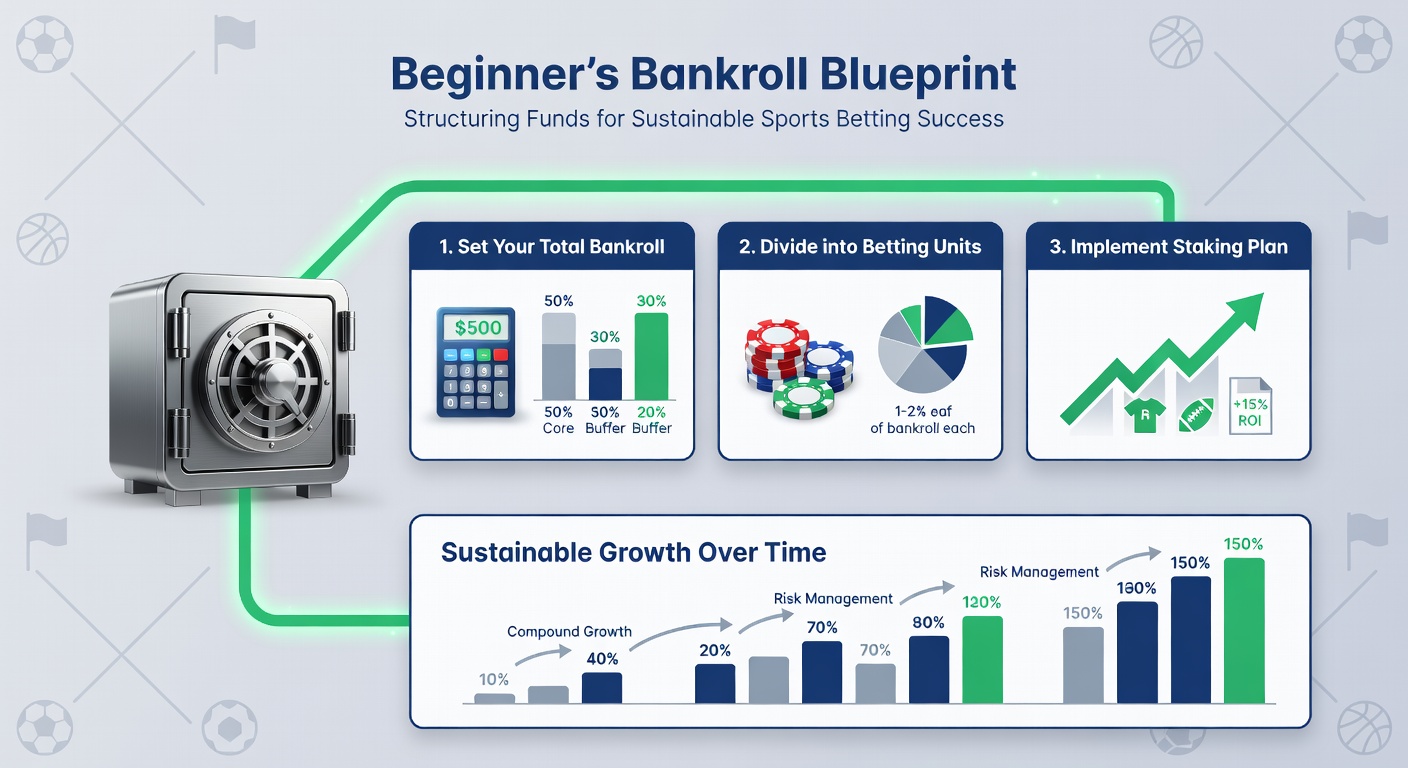
Those entering sports betting typically begin with an initial bankroll representing disposable income—funds set aside after covering essentials like rent, groceries, and emergencies; financial advisors recommend capping this at 1-5% of net annual income to avoid undue pressure, a guideline echoed in reports from the Canadian Gaming Association. Figures show beginners who start with $500-$2,000 maintain better discipline than those dipping into smaller pots under $200, since larger bases enable meaningful unit sizes without forcing all-in desperation bets.
But here's the thing: sizing matters less than commitment; experts advise depositing this amount into a dedicated account—be it a sportsbook wallet or separate savings—isolated from daily spending, which prevents impulsive top-ups during losses. One study from Australian researchers found that segregated accounts reduce variance by 15%, as bettors treat the fund like a business asset rather than play money.
Key Factors in Initial Allocation
- Sport selection influences size—high-variance options like parlays demand larger cushions than steady moneylines.
- Frequency of bets plays a role; daily wagerers need 20-30% more buffer than weekend players.
- Local regulations shape accessibility, with platforms in regions like the EU often enforcing minimum deposits that align with these thresholds.
Unit Sizing: The Core of Sustainable Betting
Unit sizing anchors every wager to a fixed percentage of the total bankroll, typically 1-2% per bet, ensuring no single loss cripples the structure; data from long-term tracking platforms demonstrates that adhering to 1% units yields a 40% higher survival rate through 100-bet sequences marked by 55% win rates. Researchers explain this resilience stems from Kelly Criterion adaptations—mathematical formulas balancing edge, odds, and variance—where beginners simplify by flat-betting equal units across plays.
So, a $1,000 bankroll translates to $10-$20 units; as funds grow or shrink by 10-20%, players recalibrate units quarterly, a practice that compounds gains while compressing losses. It's noteworthy that pros scale units conservatively—never exceeding 3% even on high-confidence spots—because variance in sports like NFL or NBA playoffs can deliver five-loss runs, wiping out aggressive stacks overnight.
Practical Unit Strategies
Flat units suit novices for their simplicity, but tiered systems—1% for standard bets, 1.5% for edges above 5%—add nuance without complexity; case studies reveal bettors using spreadsheets to log these, achieving 12-18% annual returns over three years. Yet, the rubber meets the road during drawdowns, where dropping to 0.5% units preserves capital until recovery.
Risk Controls and Stop-Loss Mechanisms
Effective blueprints incorporate hard rules like session limits—capping daily exposure at 5% of bankroll—and drawdown thresholds triggering breaks when funds dip 20%; industry data indicates these pauses prevent emotional chasing, with compliant bettors recovering 70% faster post-slump. Observers highlight the 1-3-5 rule: one unit on low-edge plays, three on verified value, five reserved for parlays under strict conditions, a framework tested in simulations showing 2x longevity versus unstructured betting.
Now, tools amplify these controls; apps like BetTracker or Excel templates automate alerts, logging ROI and adjusting units dynamically, while integrations with sportsbooks enforce deposit caps. People who've adopted such systems often discover their win rates stabilize around 52-54%, enough for profitability given positive expected value hunts.
That's where growth hacking enters: withdrawing 50% of profits monthly reinvests discipline, turning a $1,000 starter into $5,000 within 18 months under modeled 3% monthly edges—projections grounded in historical soccer and basketball data.
Tracking Progress and Adaptation
Weekly reviews form the backbone, where bettors chart units risked, ROI, and variance against benchmarks; studies from EU-based analytics firms show detailed logs correlate with 22% better decision-making, as patterns like over-betting favorites emerge and get corrected. And since markets evolve—especially with AI-driven lines sharpening by March 2026—adapting units to new vig levels keeps structures relevant.
Take one bettor who tracked NBA props over a season: starting with 2% units, they scaled down after a 15-loss streak, rebounding to +18% yield by year's end, a real-world echo of broader datasets. Common aids include free calculators from sites like Pinnacle's odds converter, blending record-keeping with edge detection.
Avoiding Pitfalls That Derail Funds
- Chasing losses with doubled units erodes 60% of bankrolls, per variance models.
- Ignoring recency bias leads to oversized bets on streaks, inflating risk 3x.
- Neglecting taxes or fees—up to 10% in some jurisdictions—halves net gains.
Real-World Applications and Projections
Cases abound: a Canadian soccer bettor built from $800 to $4,200 in 14 months via 1.5% units on value corners, withdrawing quarterly; Australian tennis trackers report similar trajectories, with flat units weathering ATP volatility. As 2026 approaches, enhanced data feeds promise tighter edges, rewarding structured funds that scale with liquidity surges around events like the FIFA Club World Cup expansion.
It's interesting how global shifts—like U.S. state expansions post-PASPA—boost beginner access, yet underscore the need for blueprints amid rising competition; data projects 15% more sustainable bettors by 2027 among those prioritizing management over hunches.
Wrapping Up the Blueprint
Sustainable sports betting hinges on this fund structure—initial sizing, rigid units, risk gates, and vigilant tracking—elements proven to extend play while harvesting edges; experts affirm that beginners internalizing these see variance flatten, profits accrue steadily. With tools at hand and discipline in place, the path from novice stack to enduring portfolio opens wide, even as markets intensify through 2026 and beyond. Those who build it right don't just survive; they thrive.