Bayesian Refinement of Win Probabilities Across Successive Horse Races
Gisela Lange · Jun 19, 2026
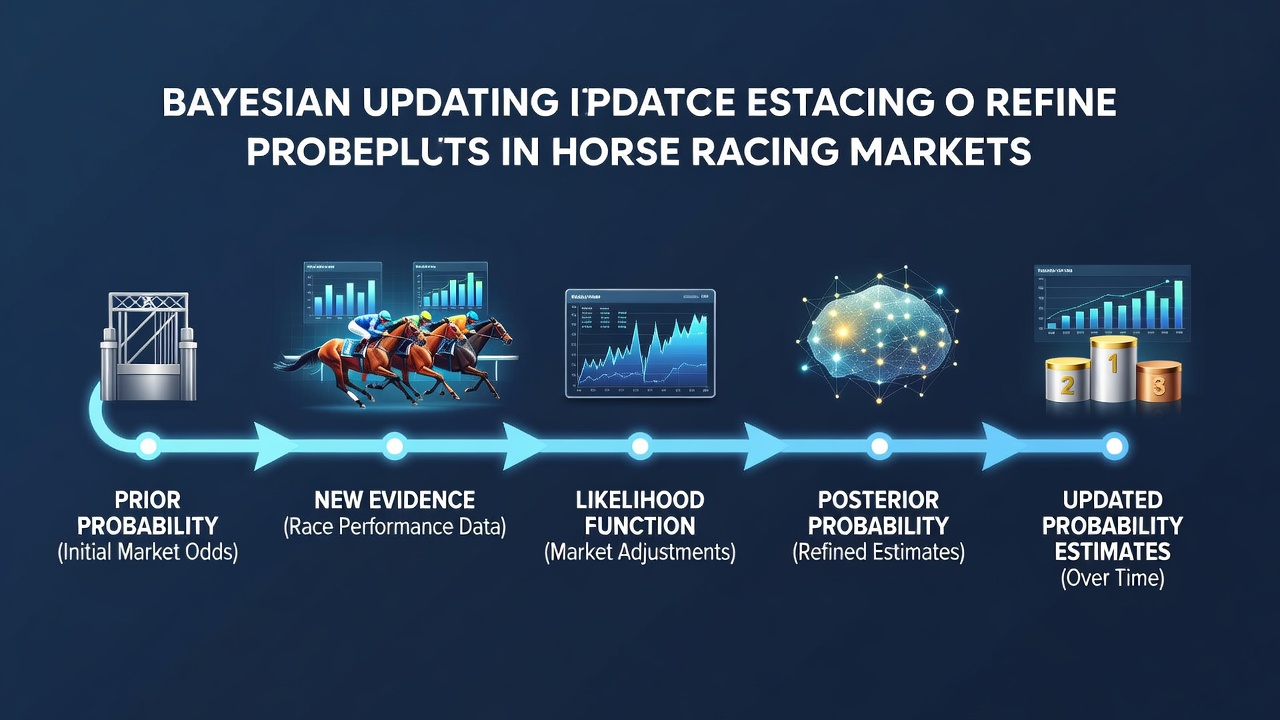
Bayesian Refinement of Win Probabilities Across Successive Horse Races
Bayesian updating provides a structured method for adjusting initial probability estimates as new information arrives from each race result, track condition change, or jockey performance shift in horse racing markets. Researchers apply this approach by starting with a prior distribution that reflects historical data on a horse's past finishes, then multiplying that by a likelihood function derived from the latest observations to produce an updated posterior probability. Markets incorporate these refined estimates when odds adjust between events, and analysts track how the process evolves over sequences of races rather than treating each contest in isolation.
Core Mechanics of the Updating Process
Analysts define the prior as the initial belief about a horse's win chance based on career statistics compiled from previous seasons, while the likelihood captures how well the current race conditions match those historical patterns. The posterior then combines both elements through Bayes' theorem, expressed as the normalized product of prior and likelihood, which yields a new probability distribution ready for the next race. Data from multiple meetings show that repeated applications of this cycle reduce variance in estimates because each update incorporates fresh evidence without discarding earlier records entirely.
Software tools used by professional syndicates implement these calculations in real time by feeding live results into the model after every finish, and observers note that the method handles uncertainty from variables such as pace scenarios or equipment changes more systematically than static rating systems. When a horse returns from a layoff, the prior receives heavier weighting until sufficient new races accumulate, whereas consistent performers see their likelihood terms dominate the calculation sooner.
Application Over Multiple Race Cycles
Sequential updating begins before a horse's first start in a new campaign and continues through subsequent outings, with each posterior becoming the prior for the following event. Studies of Australian thoroughbred data reveal that models using this framework improve calibration of implied probabilities against actual outcomes after five or six races compared with single-race assessments. Market participants adjust betting lines accordingly, and figures from the same dataset indicate tighter clustering around true win rates once the updating process stabilizes.
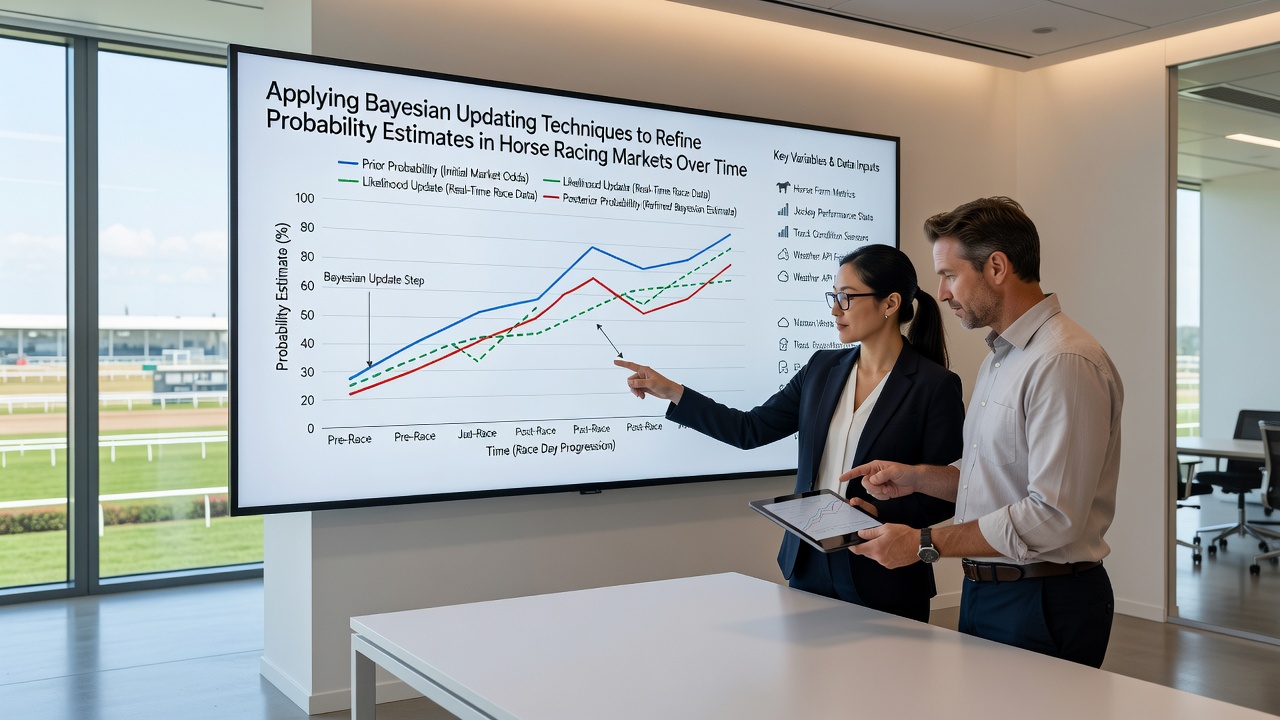
Trainers release workout times and veterinary reports between meetings, supplying additional likelihood inputs that refine the distribution further. Those who monitor these signals integrate them into the model before the next race card is finalized, and the resulting posteriors often diverge from opening odds when public information lags behind the updated evidence. In June 2026, several syndicates reported using expanded datasets that included GPS-derived speed figures to sharpen likelihood calculations during the Australian winter carnival period.
Integration With Market Dynamics
Betting exchanges display odds that reflect aggregated trader beliefs, and Bayesian models allow individual participants to compare their private posteriors against those displayed prices. When a discrepancy appears, the model guides position sizing based on the magnitude of the difference between personal probability and market-implied probability. Research published by the National Thoroughbred Association of Australia examined thousands of races and found that traders who applied sequential updates achieved closer alignment with realized results than those relying on fixed ratings alone.
Weather shifts and track bias changes introduce new data points that the likelihood function absorbs without requiring complete model resets, and this continuity preserves information across varying conditions. Canadian researchers at the University of Guelph documented similar patterns in harness racing, where posterior estimates converged faster when models accounted for driver changes alongside horse form.
Practical Implementation Considerations
Model builders must select appropriate prior distributions, often choosing beta or Dirichlet forms because they conjugate nicely with binomial or multinomial likelihoods common in win-place-show outcomes. Hyperparameters tuned on large historical samples prevent excessive shrinkage toward zero or one, and validation sets drawn from later seasons confirm that the chosen priors produce well-calibrated forecasts. Computational efficiency matters when updating occurs between races on the same day, so analysts precompute certain integrals or use approximate methods such as variational inference to maintain speed without sacrificing accuracy.
External factors such as international form lines require translation into compatible likelihood terms, and syndicates maintain separate modules that convert foreign speed ratings into domestic equivalents before feeding them into the main updating engine. Those modules update independently and feed summary statistics into the central posterior calculation, keeping the overall process modular and extensible.
Conclusion
Bayesian updating supplies a repeatable framework for incorporating successive race results into probability estimates, and markets reflect these refinements through ongoing odds adjustments. Continued application across multiple seasons demonstrates measurable improvements in calibration when models receive regular likelihood inputs from new observations. Industry reports and academic examinations confirm that structured updating distinguishes itself from ad-hoc revisions by maintaining consistency while adapting to evolving conditions.