Cross-Market Line Shifts: Sequencing Matched Plays Through Calculator Allocation Models
Viktor Zimmermann · Jul 17, 2026

Cross-Market Line Shifts: Sequencing Matched Plays Through Calculator Allocation Models
Line movements across separate betting markets create opportunities when traders identify correlations that allow matched plays to lock in outcomes while calculators handle stake distribution. Observers note that these shifts occur when odds adjust in response to volume, news, or liquidity changes in one venue while remaining stable in another and this divergence forms the basis for sequencing entries that reduce exposure across correlated selections.
Understanding Line Movements in Multiple Venues
Markets for the same event often diverge because sportsbooks and exchanges operate with different risk tolerances, client bases, and update frequencies so a line that moves sharply on one platform may lag on another. Data from regulatory filings in Nevada indicate that volume spikes frequently precede adjustments of 0.5 to 1.5 points in major sports while smaller exchanges adjust more slowly. Those who track these patterns use timestamped feeds to isolate moments when one market has reacted but the complementary selection elsewhere has not yet aligned and this lag window supports the creation of matched positions that offset risk across both sides of an outcome.
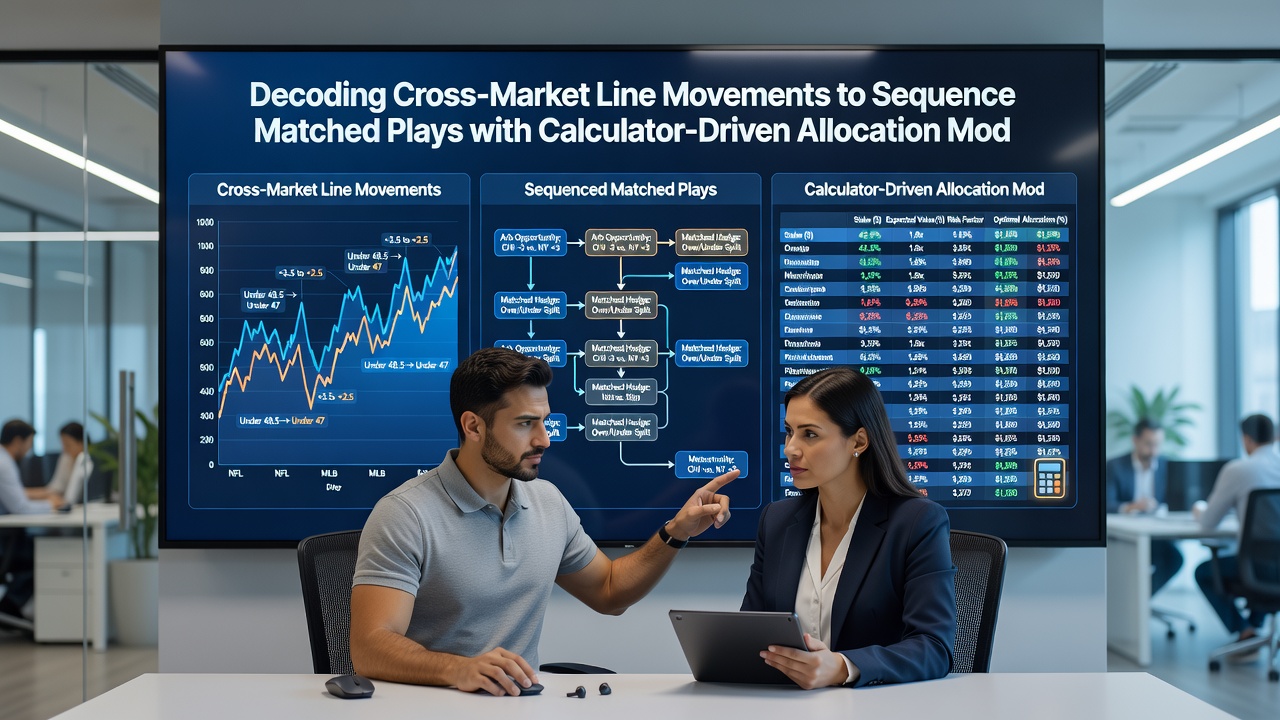
Calculators enter the process by converting observed line values into stake allocations that equalize potential returns regardless of which side resolves. Researchers at academic institutions studying quantitative finance have documented how allocation algorithms distribute capital proportionally to implied probabilities derived from live odds feeds and these models update continuously as new prices appear. In practice the sequence begins with identification of a cross-market discrepancy followed by calculator input of current lines and then automated output of stake amounts that balance exposure.
Sequencing Matched Plays with Allocation Tools
Sequencing refers to the ordered placement of bets across correlated markets so that each step reduces net variance. One documented approach starts with an initial position in the market showing the sharpest movement then adds a counter-position in the lagging market once the calculator confirms the required stake ratio. Reports from the Australian wagering sector highlight how operators monitor simultaneous line changes in domestic and offshore books during major events and these observations have informed the design of allocation models that account for currency conversion and settlement timing differences.
Allocation models rely on inputs such as current decimal odds, available liquidity, and historical correlation coefficients between markets. When lines move in one venue due to heavy action on a favorite the calculator recalculates required stakes on the opposing side elsewhere to maintain a near-zero net position after commissions. Figures released by the American Gaming Association show increased use of such tools among professional operators in 2025 and early 2026 with adoption rates rising alongside the availability of real-time data APIs.
Practical Implementation and Data Inputs
Implementation begins with data ingestion from multiple sources followed by normalization of odds formats and then application of correlation filters that exclude unrelated events. Calculators apply formulas that solve for stake amounts satisfying the condition that total return remains constant across possible outcomes. Studies published in quantitative journals demonstrate that models incorporating time-decayed correlation data outperform static allocations during periods of high volatility such as playoff rounds or international tournaments. As of July 2026 several platforms have integrated these calculators directly into trading terminals allowing operators to execute sequenced entries within seconds of detecting a cross-market discrepancy.
Geographic variation affects model performance because settlement rules and tax structures differ between jurisdictions. Canadian provincial regulators require separate reporting for matched positions while European operators often apply different commission schedules on exchanges. Allocation calculators therefore include jurisdiction-specific parameters that adjust output stakes accordingly and this customization helps maintain compliance while preserving the mathematical balance of each sequence.
Conclusion
Cross-market line movements supply the raw signals that allocation calculators convert into sequenced matched plays. teh process depends on timely data feeds, accurate correlation measurements, and jurisdiction-aware stake calculations. Evidence from regulatory reports and academic research confirms that these techniques operate within existing market structures and that their application continues to expand as real-time connectivity improves. Observers tracking developments through mid-2026 report steady integration of such models into professional workflows across multiple regions.