Referee Styles and Their Effects on Over/Under Outcomes in Professional Football
Viktor Zimmermann · Jun 8, 2026

Referee Styles and Their Effects on Over/Under Outcomes in Professional Football
Referee tendencies shape football matches in ways that extend beyond simple rule enforcement, and those patterns create measurable effects on total goals scored across professional leagues. Data from major competitions reveal consistent differences in how officials manage physical play, issue cards, and allow game flow to develop, which in turn influences the number of scoring opportunities that arise during ninety minutes plus stoppage time.
Core Metrics Referees Influence in Totals Markets
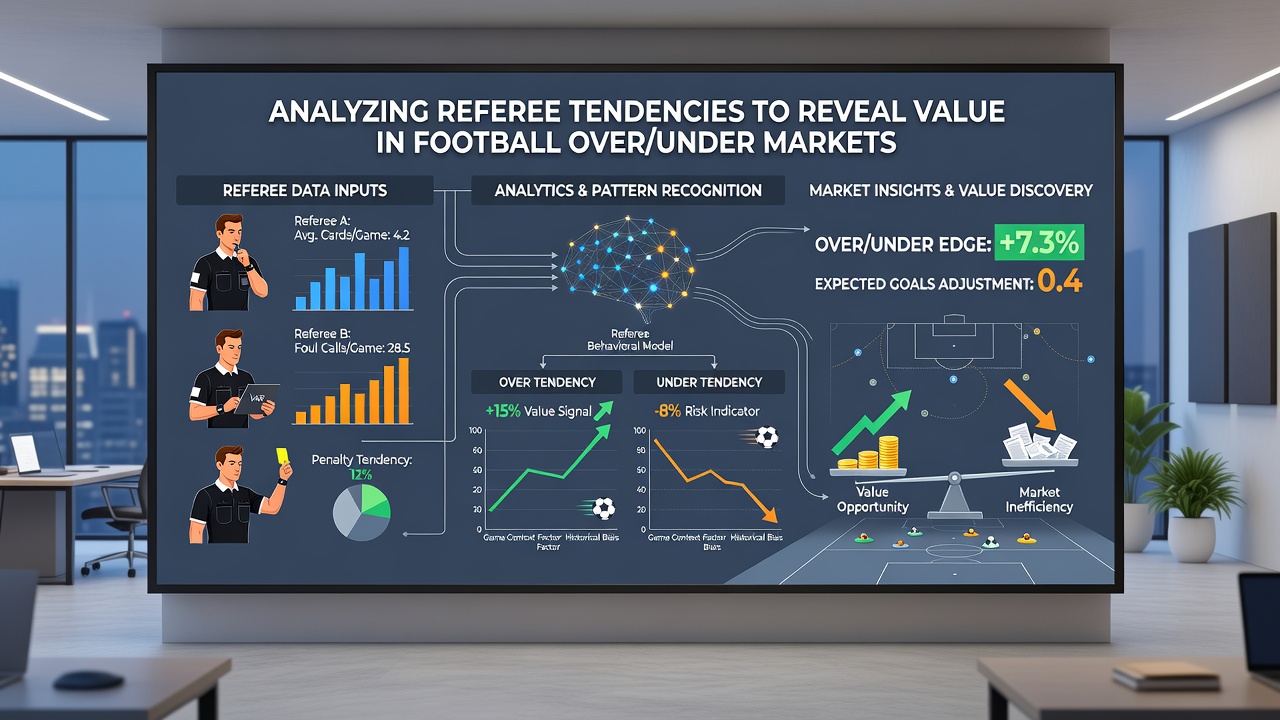
Analysts track several referee-specific statistics that correlate with over and under results, including average fouls per match, cards issued, penalty awards, and time added at the end of each half. These figures vary significantly by official and by competition, so bettors who compile season-long databases can identify which referees tend to produce higher or lower goal outputs when assigned to particular fixtures. One study covering five European leagues between 2022 and 2025 found that referees averaging more than twenty-six fouls per game produced under results 53 percent of the time, while those averaging fewer than twenty-one fouls saw overs hit at a 51 percent clip.
Data Collection and Pattern Recognition Across Leagues
Comprehensive tracking begins with public match reports and expands through detailed event data providers that log every whistle and card. Observers note that patterns emerge most clearly when referees work multiple games in the same league or when they travel across borders for continental fixtures. In June 2026 several top divisions released updated referee performance dashboards that included breakdowns by home versus away assignments, allowing deeper segmentation of tendencies that affect total goals. Those dashboards confirmed earlier findings that certain officials add more stoppage time in matches featuring two high-pressing teams, which indirectly increases the window for late goals and pushes totals higher.
Regional Variations and Cross-Border Assignments
UEFA reports highlight how referee pools from different member associations apply distinct interpretations of the same laws, creating predictable variance when officials cross borders. UEFA referee performance summaries show that officials from leagues with stricter foul thresholds often produce fewer goals when assigned to matches featuring technically oriented sides. Meanwhile, data compiled by performance analysts in Major League Soccer demonstrates that referees who issue higher card counts in domestic play maintain similar rates when working international friendlies, giving bettors a stable baseline for projecting totals in those contests.
Integration With Team Styles and Fixture Context
Referee data gains predictive power when combined with team tactical profiles and current form indicators. A referee who allows high foul counts can suppress scoring when two defensive-minded sides meet, yet the same official may produce elevated totals when fast-transition teams play against one another. Researchers at performance analytics firms have documented cases where a single referee’s assignment shifted a match’s expected goal total by 0.4 goals on average, enough to move a line across common betting thresholds. Those shifts become especially relevant in midweek cup ties where referee rotation creates mismatches between typical league officials and the appointed crew.
Building and Testing Predictive Models
Quantitative approaches rely on regression models that treat referee identity as a fixed effect alongside team strength ratings and venue factors. Back-testing these models across multiple seasons shows that isolating referee tendencies improves forecast accuracy for totals by between 3 and 7 percent compared with models that ignore the official. Bettors who update their databases weekly can capture shifts caused by rule changes or new referee promotions, maintaining an edge as tendencies evolve. The process requires disciplined record-keeping rather than intuition, since small sample sizes around individual officials can produce misleading signals until several seasons of data accumulate.
Conclusion
Referee pattern analysis supplies an additional layer of information that sharpens projections in football over/under markets when layered onto existing team and situational data. Leagues continue to publish more granular statistics each season, including those released around June 2026, which expands the raw material available for systematic review. Observers who maintain updated referee profiles and test them against historical results find repeatable edges that arise directly from differences in how officials manage the flow and physicality of matches.